Although historians still debate the exact origins of chess, most generally agree that the game was invented sometime during the 5th-early 7th centuries AD in northern India, where it was known as chaturanga.
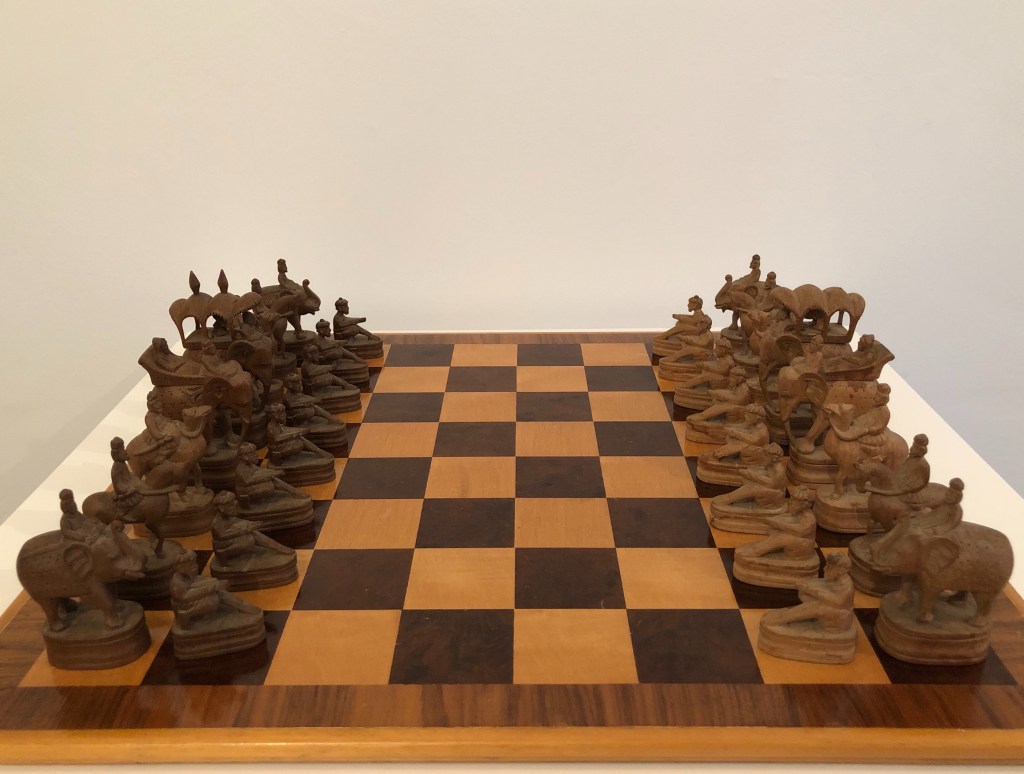
According to Michael Mark, the editor of the Chess Collector from 1988 to 1995:
“Chaturanga or caturanga originally meant four elements or arms, and the term had been used in Sanskrit literature from an early date to describe the four parts of the Indian army: elephants, cavalry, chariots and foot soldiers. These were also the pieces, together with the raja and mantrin or counsellor, which were used in the game of chaturanga, which was thus a representation on the board of a conflict between Indian armies.”
Chaturanga eventually lost the meaning of four parts and was used to mean “army.”
Chess existed by the 7th century AD but could have existed earlier, likely having developed from another form of game. Some historians have argued that chess originally was a four-handed game since chaturanga was often used to denote four-handed dice chess variants in India, with the name buddhibala or buddhiyuta denoting a two-sided game of intellect. However, most scholars currently claim that four-handed chess is a variant of the two-handed version. This argument is based on the lack of evidence that any Indian four-handed game spread beyond India and written references, such as a pre-1000 CE Indian text called Nitivakyamurta, that suggest that chaturanga could have been two-handed. However, some historians also contend that chess did not evolve from chaturanga but from divination techniques and rituals, army training exercises using miniature units on a grid, or mathematical exercises using a 64-squared board.
What Did Chess Originally Look Like?
Typically, we think of chess boards today as being checkered black and white, but the first chess boards did not have black and white squares. Apostolos Spanos explains, “The squares were normally white and divided by thin red or black lines. Later, to make the board friendlier to the players, half part of the squares was painted, in the beginning most probably red. But in time chess boards were homogenized. Thus, the board copied the black and white colouring of the pieces.” This coloring may provide symbolic value, such as readings of the game related to medieval Indian metaphysics and cosmology.

Chess pieces and rules are also very different today than when the game first began. The four parts of the Indian army, chariots, elephants, cavalry, and infantry, along with the king and his general, were the game pieces. Our understandings of the first names and moves of the pieces come from Persian written works. When the game travelled to Persia, the Persians kept the six different figures and the board with 64 squares but renamed the pieces with Persian names. One Persian source, Chatrang-namak (750-850 CE), accounts for one of the starkest differences between modern day chess and its ancestor: The modern-day queen was originally a counselor or vizier and was only able to move one square diagonally, making it one of the weakest pieces in the game. Mark further summarizes the pieces and moves seen in the Chatrang-namak:
“Instead of bishops, we find elephants, able to move only two squares diagonally, so that each of them could cover only eight squares on the board. Castling was unknown, and instead of castles at the four corners of the board we find rukhs, with the same moves as the modern rook. The Chatrang-namak offers no description of the rukh, although it describes every other piece. It is uncertain what it represented, but, as we shall see, in India the equivalent piece was a chariot. The horses had the same moves as the modern knight, but the pawns or footsoldiers had yet to enjoy the advantage of the initial double leap.”
When the game migrated to Europe, the pieces changed to reflect medieval feudal society. The chess queen began to replace the vizier by 1000 CE and was widespread around 1200 CE. The movements that she makes today did not come until the 15th century, which is made evident by Lucena’s The Art of Chess (Arte de axedres), a Spanish book that describes the differences between “old” and “new” chess. The horse also became a knight, the chariot a tower (or castle/rook), and the elephant a bishop, which reflect the figures of today’s pieces. Only the footsoldier (pawn) and king remained unchanged.
More on the origins and history of chess…

Persian Chess
On the Eastern Origins of Chess Though the exact origin of chess has for some time been contested, many have convincingly argued that based on archaeological and etymological evidence, chess originated in India as a war game called chaturanga around the 6th century CE. Called caturaṅga in Sanskrit, the word derives from catuh, meaning “four”…

 Medieval Dayraven