
On the Eastern Origins of Chess
Though the exact origin of chess has for some time been contested, many have convincingly argued that based on archaeological and etymological evidence, chess originated in India as a war game called chaturanga around the 6th century CE. Called caturaṅga in Sanskrit, the word derives from catuh, meaning “four” and anga, meaning “arm” or “limb,” with earliest references in the Rgveda, Šatapatha Brãhmana, and the Rāmāyaṇa to the four arms of war: elephants, foot soldiers, cavalry, and chariots (Bhatta 27). The “four arms” of war eventually became pieces in the game chaturanga and its Persian derivative, chatrang. Chaturanga also inspired Chinese xiangqi, Korean janggi, Japanese shogi, Burmese sittuyin, Thai Makruk, and European chess (Murray 25).
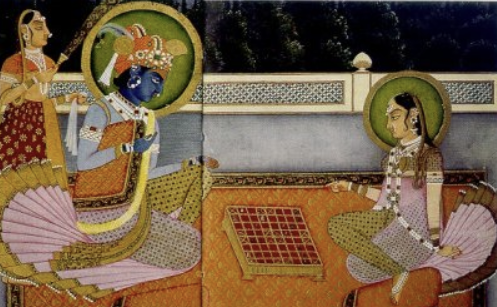
The game was gifted by an Indian king to the Sassanid Emperor Khosrow Anushirvan, whose reign during the Middle Persian Period extended from 531 to 579 CE. Called chatrang in Persia, the game quickly became popular among the nobility who associated it with power, wealth, intelligence, and strategy (Bhatta 26). Chatrang was also referenced in several Middle Persian books, including the Chatrang Nâmag, Kar-Namag i Ardashir i Pabagan, Khosrow ridag, and later in Ferdowsi’s Shahnameh 1010 CE (Murray 149-58; 169).
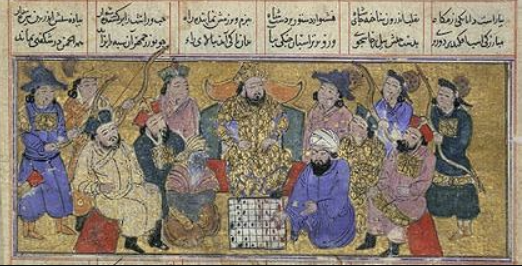
Once adopted from India by the Persians, chatrang’s gameplay was slightly modified and the pieces were given Persian names. See the charts below for a comparison:
Chaturanga
| Piece | Moves |
| Rajah (king) | One step in any direction |
| Mantri (minister) | One step diagonally in any direction. This becomes the queen in chess |
| Ratha (chariot) | Moves are the same as a rook in chess |
| Gaja (elephant) | 1) Two squares in any diagonal direction; 2) one step forward or back in any diagonal direction; 3) two squares in any vertical or horizontal direction |
| Ashva (horse) | Moves are the same as a knight in chess |
| Padati (foot soldier) | Moves are the same as a pawn in chess, but without the double step option in the first move |
Chatrang
| Piece | Moves |
| Shah (king) | Moves are the same as the king in chess |
| Firzan (minister) | One step diagonally in any direction. This becomes the queen in chess |
| Rukh (no meaning) | Moves are the same as a rook in chess |
| Fil (elephant) | Two squares in any diagonal direction. This becomes the bishop in chess |
| Faras (horse) | Moves are the same as a knight in chess |
| Baidaq (foot soldier) | Moves are the same as a pawn in chess, but without the double step option in the first move. Also, it promotes to a firzan when reaching the last row. |
In chaturanga, a win can be achieved by capturing all pieces but the rajah, leaving that piece exposed. In chatrang, there are “three ways of winning: 1) Checkmate the Shah. Shah mat meant ‘the King is dead’ in Persian, and this has been transmitted with phonetical evolution to give the word ‘checkmate’; 2) stalemate when the only possible move was putting the Shah in capture. (This is a draw in modern Chess); and 3) bare the opposite Shah, leaving him isolated with all his army captured” (Cazaux).
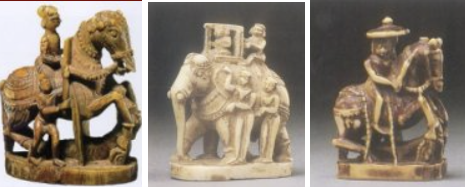
After the Sassanid Empire fell to the Muslim Caliphate (632 to 651 CE), the “ch” sound in chatrang shifted to an “sh” at the beginning of the word because there is no “ch” equivalent in Arabic. The name of the game, therefore, became shatranj around the 7th century but did not gain widespread popularity in the Muslim world until around the 9th century (Cazaux).
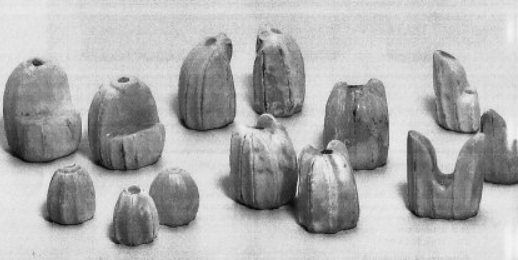
By the 10th century, Islamic travelers brought chess to North Africa, Sicily, and Spain, where it eventually spread to the rest of Europe and Russia in the Middle Ages. Still a popular game today, chess is played all over the world. According to Marylin Yalom, sometime after the game was adopted in Spain in addition to minor changes in gameplay, two major changes occurred with the pieces: the elephant became the bishop and the minister, the queen. With that shift, both pieces gained more range and movement, changing the game significantly from its earliest Eastern origins.
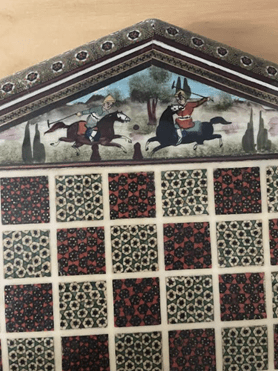
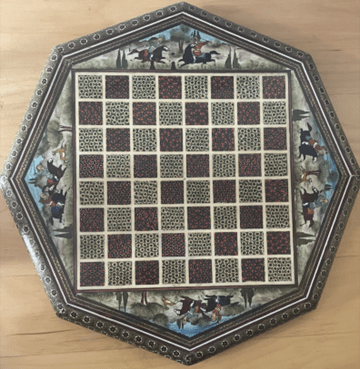
Below are some images of a modern Persian chess board, with inlays of warring knights, and the game set’s chess pieces:
Katayoun Torabi : Instructional Assistant Professor of English at Texas A&M University, specializing in medieval and early modern literature
Works Cited
Bland, N. “On the Persian Game of Chess.” The Journal of the Royal Asiatic Society of Great Britain and Ireland, vol. 13, 1852, pp. 1–70. JSTOR, http://www.jstor.org/stable/25228633. Accessed 28 Apr. 2023.
Bhatta, C. Panduranga. “INDIAN ORIGINS OF CHESS: AN OVERVIEW.” Annals of the Bhandarkar Oriental Research Institute, vol. 84, 2003, pp. 23–32. JSTOR, http://www.jstor.org/stable/41694747. Accessed 28 Apr. 2023.
“Chaturanga – The Original Chess”. Learn and play online chess. Retrieved 2022-02-12.
Darkness1089 at the English-language Wikipedia, Public domain, via Wikimedia Commons
Ferdowsi, Public domain, via Wikimedia Commons
Gardner, Iain. “Backgammon and Cosmology at the Sasanian Court.” Bulletin of the School of Oriental & African Studies, vol. 83, no. 2, June 2020, pp. 249–57. EBSCOhost, https://doi.org/10.1017/S0041977X20002177.
Jean-Louis Cazaux (2012-04-20). “Shatranj”. History.chess.free.fr. Retrieved 2013-11-23.
Murray, H. J. R. A History of Chess. Oxford University Press, 1913.
Yalom, Marilyn. Birth of the Chess Queen: A History Paperback – April 26, 2005 by Marilyn Yalom Harper Perrenial
 Medieval Dayraven